 Bader Alfar
When you buy an Apple device in Syria, you might think the hard part is over once you open the box and switch it on.
For a Syrian user, that can be exactly where the trouble starts.
Creating an account, downloading apps, using iCloud, turning on certain services, even activating a device like an Apple TV: these are all meant to be routine steps. When Syria is not officially supported by Apple's services, each of them can turn into a chain of workarounds.
This is not a problem with one app or one feature. It is an entire experience shaped by the restrictions on Syria, and by the workarounds people are forced into to get past them.
In this article I share part of my own experience, what I have seen with other users, and why some of these workarounds can become a privacy and security problem.
It starts with the account
One of the first obstacles a Syrian user meets is creating an Apple Account and using the services tied to it the normal way.
When Syria is not supported in the official sign-up flows and services, people start looking for another way in.
That is where the unofficial fixes come in: ready-made accounts, the phone numbers of people abroad, or a phone shop that creates the account on your behalf.
It can seem simple at first. The problem is that the account holding your photos, your files and your device data should be under your control, not someone else's.
When an iCloud account is something you buy
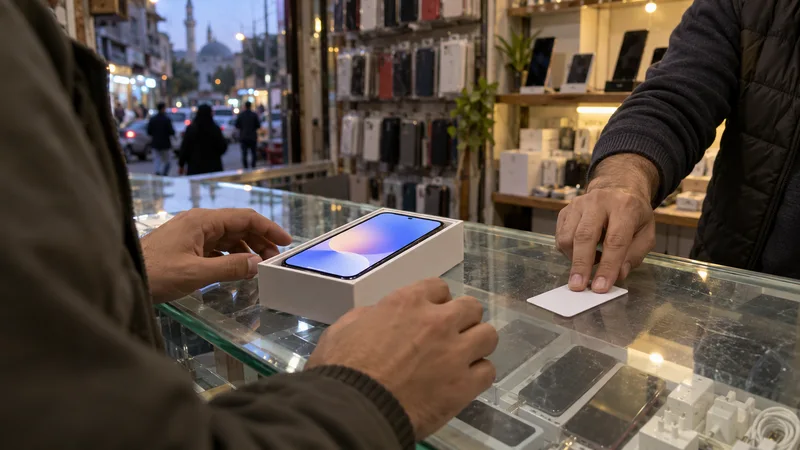
One of the fixes that has appeared on the market is buying a ready-made account, sold in phone shops as a card or a service.
The buyer gets the login details for an account that was created in advance, and it may be tied to a phone number they have never owned.
That is the core problem: you do not necessarily know who created the account, who holds the means to recover it, or what happens if you lose access to it.
Worse still, some users have their accounts created for them in phone shops, where the account may be set up with a phone number they do not own or with details that do not stay under their control.
It can look like a practical way past the first hurdle, but it puts the most important account on your device in someone else's hands.
If the phone number used to verify the account is borrowed, or can be resold, the user may lose one of the main ways to recover the account later.
And relying on someone else to create the account means that person may know the login details or the recovery information, depending on how the account was set up.
This is about more than losing an account.
An Apple Account can be linked to photos, files, backups, notes and other personal data, and also to services that help locate or manage devices.
So handing the creation of your account to someone else is not just a shortcut through a technical step. It can be a real risk to your privacy and to your control over your data.
The "Asian" account
I came across a case myself that shows how the problem can begin with something as simple as downloading an app.
A friend had bought a new iPhone and wanted to download PUBG. When he tried to sign in, something was wrong with the account.
When I checked the phone, I found that the Apple Account on it was registered in an Asian country.
I asked him where the account came from. He told me he had bought it on the market, on a card that came with a ready-made account.
A different region can mean a different store, with apps or content that differ from what the user expects.
But that is not the only problem.
The more important question is: who actually owns the account?
If the account never belonged to the user in the first place, relying on it to store personal data or to link several devices is a risk that should not be ignored.
What happens if you lose control of the account?
The trouble with an account whose recovery methods the user does not hold is that losing the password or the verification method can mean losing access to the account itself.
In some cases, accounts can also be linked to services like Find My, which is used to locate and manage devices.
So relying on an account that someone else created raises a basic question:
Do you really own your account, or are you using an account whose keys someone else holds?
That difference matters a great deal when the account is tied to a device full of photos, files and personal data.
What about relatives' numbers abroad?
Some users choose a relatively safer option: asking a relative or a friend outside Syria to create the account or to receive the verification code.
That is better than buying an anonymous account, but it does not fully solve the problem.
If the phone number is a core part of how the account is recovered, then the number changing, being cancelled, or slipping out of its owner's control can cause problems for the user later.
So the simplest rule still stands: the ways to recover your account should be under your own control.
When a VPN becomes part of daily use
The problem does not stop at creating the account.
Even once the device is up and running, Syrian users face restrictions on some Apple services and on the App Store, which pushes many of them to use a VPN to reach them.
That brings another problem: some VPN services, especially free ones, can change the IP address, or the country a service sees, from one connection to the next.
For a store that depends partly on the region, the account and where the connection comes from, this can lead to confusing results: apps that appear and then disappear, updates that look available one time and unavailable the next, or the store showing different content.
The problem is not only that users need a VPN. It is that they may have to use one again and again, even for tasks that should be ordinary, such as updating apps or reaching certain services.
My experience with Apple TV
My experience with Apple TV was a clear example of how complicated these workarounds can get.
I bought an Apple TV outside Syria and tried to activate it with my account, but ran into a problem with region support.
In the end I had to set up a VPN on the router itself, so that the whole network's connection appeared to come from outside Syria.
It worked, but the experience alone was enough to show the absurdity of it:
A device I bought the normal way needed my entire network setup changed before I could use it.
And it did not end there. Every time I wanted to go back to the device and watch something, I found myself dealing with the connection address and the region all over again, even though the device itself was up to date.
That is not a normal user experience, and it should never be accepted as one.
It is not only the iPhone
Some people assume these problems only affect phones, but they reach across Apple's wider ecosystem.
Mac, iPad, Apple Watch, Apple TV and other devices all depend, to different degrees, on the account, the region and the services tied to them.
So when core services are unavailable to Syrian users, the problem does not go away just because you switch devices.
You can buy the device in another country, but in the end you come back to the same question:
Are the services you paid for when you bought the device available to you from Syria?
Services that do not reach Syrian users
One direct result of these restrictions is that some services that have become a core part of Apple's ecosystem cannot be used by Syrian users the way users in supported countries use them.
Examples include services tied to iCloud+, and others that depend on the region and the account being supported.
This leaves a clear gap between the device itself and the services that make Apple's ecosystem useful.
The device may be new and expensive, yet part of the experience you paid for stays out of reach because of the region.
Why do the restrictions outlast the sanctions?
What makes this more striking is that it comes at a time when the legal context around Syria has changed dramatically.
Broad sanctions have been lifted, and the legal environment that was one of the reasons behind the blocks companies imposed for years has changed.
But a change in the law does not necessarily mean every company updated its systems on the same day.
That is one reason we see many services gradually start to work, while others stay blocked or only partly working.
For the user, the result is the same:
The legal situation may change, but the device does not know it until the company changes its systems.
What do we need from Apple?
Not more workarounds.
Syrian users need to be able to create their own accounts, with their own details and their own phone numbers, and to keep full control over their accounts and how they are recovered.
They need to be able to download and update apps and reach core services without depending on a VPN, anonymous accounts or numbers they do not own.
And the devices they have bought need to work the way they were designed to.
This is not a luxury.
When creating an account, updating an app or getting a TV box to work depends on other people's accounts, borrowed numbers and shifting IP addresses, the problem is no longer just "a blocked service".
It is an entire digital life built on working around restrictions.
The bottom line
The struggle of Apple users in Syria cannot be reduced to being unable to open one service.
It is a chain that starts with creating an account, runs through the App Store, iCloud, the different devices and services like Apple TV, and sometimes ends with relying on unofficial workarounds that can cost users control of their account or their data.
The most dangerous thing about some of these workarounds is that they have come to feel normal, simply because so many people use them.
Buying a ready-made account, using someone else's number, having the account created in a shop, switching on a VPN every time you want to reach a service: all of these appeared because the official path is closed.
But none of them is a real substitute for making the service available.
In the end, what Syrian users need is simple:
To buy a device, create their own account, protect their own data, and use the services they paid for without a middleman or a workaround.
With Syria's legal environment changing, the question today is less about whether these doors can be opened and more about when companies will actually open them.
That is exactly the kind of gap we track at Unblock Syria: not just whether a service works, but which parts of it work, which are still closed, and why.