 Miriam Alarbaji Alsayegh
The company wanted a developer who knew Python and the Django framework. Miriam, newly graduated in 2019, knew neither.
She answered the interview questions in Java, and made the case that programming rests on being able to think and to take a problem apart. Any language or framework, she said, can be learned afterward.
She got the job.
She had done something like this once before, at eighteen, with a subject she had never chosen.
The subject she never chose
What she wanted to study was pharmacy. Her father worked in medical laboratories, and pharmacy was the field closest to anything she had seen up close. Beyond that she knew very little about what was on offer at university, or where any of it led.
Then the place she expected did not come through, and the question got harder.
Computer science was not her first choice, and it was not love at first sight. A friend, Sumaya, an IT engineer who thought the work would suit her, told her to give it a go. Miriam decided she was not entitled to an opinion yet.
"I was convinced that I had no right to say I disliked something I neither knew nor understood," she says. "My goal was to understand it first, and then decide."
She started on curiosity alone, and the field came to her slowly: the logic of it first, then the particular pleasure of sitting with a problem until it gives way. During her studies she entered a programming contest with a team and they made it through to the Syrian stage. That was the turning point, the first time she could see how far this might go. It also put her in a room with the person who would hand her that first job.
Two jobs and a master's
She graduated with a good average, and the academic side of the field never quite let go of her. Postgraduate study had always been somewhere in her mind, so she enrolled in a master's and kept working at the same time.
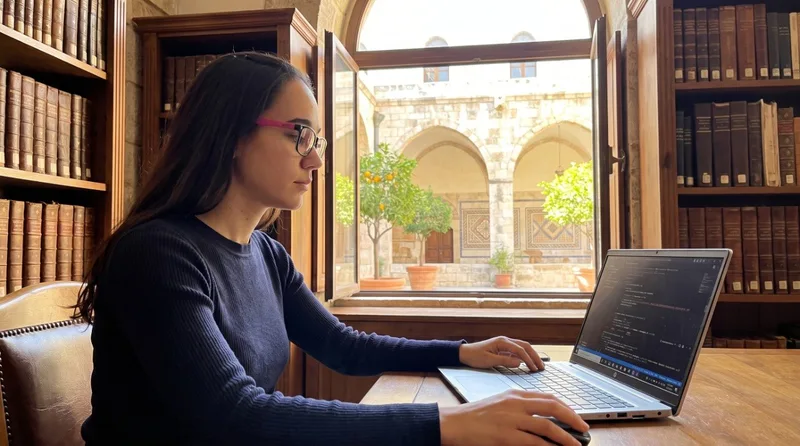
For four years she carried three things at once: the job, the master's, and teaching the practical sections for students in the faculty of informatics engineering.
The teaching is the part she talks about.
She tried to tie every session to real practice, to what the material would actually be used for once the students left the room. Many of them have graduated by now and are building careers of their own, and she is still in touch with them. Of everything she did in those four years, she counts the teaching as the thing that changed her most, and she means personally rather than professionally.
"I saw how eager these young people were, how they kept going with their studies despite everything around them," she says. "They only needed a small source of inspiration, one spark, to carry on."
She quit before she had anywhere to go
Once the master's was done, she wanted her attention back on learning and research. She sat the IELTS. Then she left her job, with nothing lined up, so that looking for somewhere to study could be the only thing she was doing.
The search took months.
What she found was a program called Applications of Artificial Intelligence at the University of Essex. It looks at how artificial intelligence gets applied in communities, which is the part that interested her, and she chose it with Syria in mind, as knowledge that could find its way home later.
She applied for a Said Foundation Scholarship. The wait was long. Then the acceptance came.
She starts in October.
The part that is easy to miss
Almost all of that depended on being in the room. She met the person who hired her at a programming contest, she made her own case across an interview table, and for four years she stood in a lecture hall giving students the practical grounding she had argued for in that interview.
Most of those rooms are online now: the course, the scholarship portal, the payment page, the professional network where an opening gets mentioned before it is ever posted. A great many of them are locked to people inside Syria, and inside Syria there are thousands of people with Miriam's ability and the same appetite for the work.
The talent and the ambition are already in the country. Access is what opens the door.
At Unblock Syria we work on taking down those barriers, because every one that falls means another person who gets to learn, to build, and to take part in the future of their country. That is the core of the work, and we will not stop until it is done.