 Fadel Abdul Ghany
Editor's note. Unblock Syria works to end the digital blocks that cut Syrians off from everyday services. Many of those blocks rest on U.S. sanctions and terrorism designations — and on companies over-complying with them. In this guest essay, Fadel Abdul Ghany — founder and president of the Syrian Network for Human Rights (SNHR) — explains the one designation that has not yet been lifted, and why it still shapes Syria's access to the world. It is adapted and updated from his analysis first published by SNHR in June 2026.
Syria has been on the U.S. list of state sponsors of terrorism since 1979 — the longest-running such designation of any country. It is still there today, even after the sweeping legal and political changes that followed the fall of the Assad regime. The reason is easy to misread. Removing Syria from the list is not a political decision made with the stroke of a pen or a ministerial signature. It is a strict legal track governed by U.S. federal law, and that track — despite real progress — is not finished.
Three things are true at once. First, the United States has dismantled the broad punitive system it built around Syria: it repealed the Caesar Act permanently and lifted the terrorism designations on Hay'at Tahrir al-Sham and President Ahmad al-Sharaa. But the state-sponsor-of-terrorism designation runs on a separate legal track that those changes do not reach. Second, completing the removal requires — under U.S. law — a formal presidential certification sent to Congress, followed by a mandatory 45-day review period during which Congress can pass a joint resolution of disapproval. The first of these has now been taken — on 8 July 2026 the President notified Congress of his decision — but the 45-day review has yet to run, and until it does the designation stands. Third, as long as the designation stands, it weighs on Syria's economic recovery: it hardens banks' reluctance to move money, blocks access to international financial institutions, and leaves the threat of legal liability hanging over anyone weighing an investment.
The progress is real and encouraging. But lifting the designation depends on finishing its full legal course — and until that happens, it remains a heavy inheritance from the Assad era.
Removing Syria from the list is not a decision made with the stroke of a pen or a ministerial signature. It is a strict legal track governed by U.S. federal law.
What has already been lifted
In the months since the Assad regime fell in December 2024, the United States moved fast. It ended its comprehensive sanctions program on Syria, repealed the Caesar Act, revoked Hay'at Tahrir al-Sham's designation as a foreign terrorist organization, removed President Ahmad al-Sharaa from the U.S. list of Specially Designated Global Terrorists and from the UN Security Council's 1267 sanctions regime, and replaced its broad sanctions architecture with a narrower, conduct-based one. And yet Syria stays on the state-sponsors-of-terrorism (SST) list. That is not political inertia — it is the binding legal procedure that governs how a country comes off the list, a process that has advanced a long way but is not yet complete.
The turning point was Executive Order 14312, signed by President Donald Trump on 30 June 2025. In a single stroke it ended the Syrian sanctions regulations, revoked six foundational executive orders, and removed 518 individuals and entities — including the Central Bank of Syria — from the Specially Designated Nationals (SDN) list. It replaced the old architecture with a narrower, conduct-based program: the Promoting Accountability for Assad and Regional Stabilization Sanctions, or PAARSS, aimed at people tied to Assad, human rights violators, Captagon traffickers, those behind the chemical-weapons proliferation program, ISIS and al-Qaeda affiliates, and Iranian proxies. In a separate and deliberate step, the same order instructed the Secretary of State to review Syria's designation as a state sponsor of terrorism. The sanctions termination and this review move on two different legal tracks.
Why removal is a legal track, not a signature
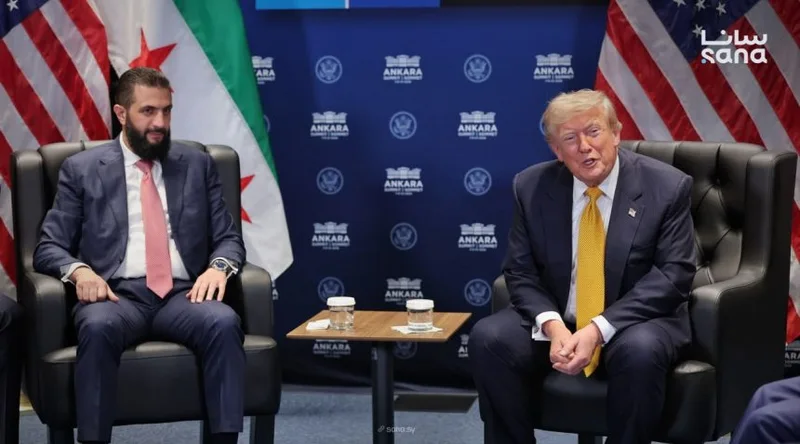
The State Department finished its review, and on 8 July 2026 it announced it was initiating the process to rescind the designation — a decision President Trump signalled alongside Syria's President al-Sharaa on the sidelines of the NATO summit in Ankara — with Secretary of State Marco Rubio confirming that the administration had notified Congress, citing the counterterrorism steps taken under al-Sharaa and Syria's formal assurances against supporting terrorism in the future. That notification is an important step — but it does not, by itself, amount to removal, contrary to what many news outlets and social-media posts have suggested.
Under U.S. law there are two legal paths for lifting a state-sponsor-of-terrorism designation, drawn from the Export Administration Act and the Arms Export Control Act. The first requires the President to certify to Congress that the designated government has not supported international terrorism in the previous six months, together with assurances that it will not do so in the future. The second applies when there has been a "fundamental change in the leadership and policies" of the government, and it too requires assurances against repetition. Either way, an official presidential certification must go to Congress — and that starts a mandatory 45-day review period before the removal takes legal effect. During those 45 days, Congress can pass a joint resolution of disapproval to stop it.
The Washington Institute for Near East Policy has judged the six-month certification path the most legally defensible in Syria's case, because it rests on a specific, verifiable evidentiary record. So the legal sequence runs: the Secretary's decision, then the formal presidential certification, then notification to Congress, then the 45-day review, and only then the formal removal. That notification to Congress was made on 8 July 2026, opening the 45-day review; the formal removal will not take legal effect until the review concludes without a joint resolution of disapproval.
Where the 1979 designation came from
The original designation, in 1979, rested on U.S. assessments of the Assad regime's support for armed Palestinian factions, its strategic alliance with Iran, and its material support for organizations designated as terrorist under U.S. law, including Hezbollah. It stayed in force throughout Bashar al-Assad's rule — reinforced by Syria's role in funneling foreign fighters into Iraq, the entrenchment of Hezbollah's military infrastructure in Lebanon, and the regime's documented use of chemical weapons.
What the designation still does
The practical consequences of the SST designation are separate from those of the executive-order sanctions, and they rest on their own legal basis. They include restrictions on U.S. foreign assistance under the Foreign Assistance Act, a ban on defense exports and sales under the Arms Export Control Act, tighter controls on dual-use exports, limits on financial transactions, and a legal duty on U.S. representatives at international financial institutions to oppose loans and aid to designated states. The designation also creates serious legal risk for companies, financial institutions, and third-country governments that deal with the designated state, exposing them to secondary designations and civil or criminal penalties under U.S. law. These effects persist independently of any waiver granted at the executive level through other instruments.
The volume of waivers already granted through those other instruments is large, and the sequence matters:
How the sanctions came down — a timeline
- 23 May 2025 — The Secretary of State issues a temporary 180-day waiver of Caesar Act sanctions.
- 30 June 2025 — Executive Order 14312 permanently ends the comprehensive sanctions program.
- 7 July 2025 — The State Department revokes Hay'at Tahrir al-Sham's foreign-terrorist-organization designation.
- 6 November 2025 — UN Security Council Resolution 2799 removes President Ahmad al-Sharaa and Interior Minister Anas Khattab from the 1267/1989/2253 sanctions regime.
- 7 November 2025 — The State Department removes al-Sharaa from the SDN list — a day before his White House visit.
- 18 December 2025 — Congress repeals the Caesar Act in full and permanently (Section 8369, NDAA for FY2026), by 312–112 in the House and 77–20 in the Senate.
- 27 February 2026 — The Security Council's sanctions committee unanimously removes HTS and all its known aliases, including Jabhat al-Nusra and Jabhat Fatah al-Sham, ending the asset freeze, travel ban, and arms embargo in place since 2014. From that date, no UN measures specific to Syria remain in effect.
- 8 July 2026 — President Trump notifies Congress of his decision to rescind Syria's state-sponsor-of-terrorism designation, and the State Department announces it is initiating the rescission process — starting the mandatory 45-day congressional review that must elapse before removal takes legal effect.
Despite this accumulation of waivers, the state-sponsor-of-terrorism designation still stands, and its persistence carries consequences the parallel measures cannot cancel. It raises reputational concerns and imposes legal risks that keep international banks, correspondent banking networks, and multilateral development lenders away from Syria — even where no technical restriction blocks a given transaction.
What removal would change
Taking Syria off the list would remove a formal barrier to direct assistance from the U.S. government to the Syrian government, normalize Syria's access to IMF and World Bank facilities, and lower the legal-risk calculations of third parties weighing investment or trade.
The process has moved a long way. With the notification to Congress made on 8 July 2026, what remains is the 45-day review that U.S. law still demands before removal takes legal effect — a window that, absent a joint resolution of disapproval, closes on or about 22 August 2026. One hopes it passes without such a resolution — and that Syria is finally lifted from a list whose persistence has become an extension of the Assad era's burdens.
Fadel Abdul Ghany founded the Syrian Network for Human Rights in June 2011 and has been its president since. He holds a Master's degree in International Law (LLM) from De Montfort University in Leicester, UK, and is a non-resident researcher at the Global Institute for Strategic Research (GISR).